Steel and post-frame homes for DFW acreage
Barndominium Builders in Dallas, TX
Barndominiums, shop houses and metal building homes planned around North Texas clay, heat and hail.
- Free on-site estimates on your land
- Written, line-item pricing
- County permit and septic research included
Barndos Built for Blackland Clay and Cross Timbers Hills
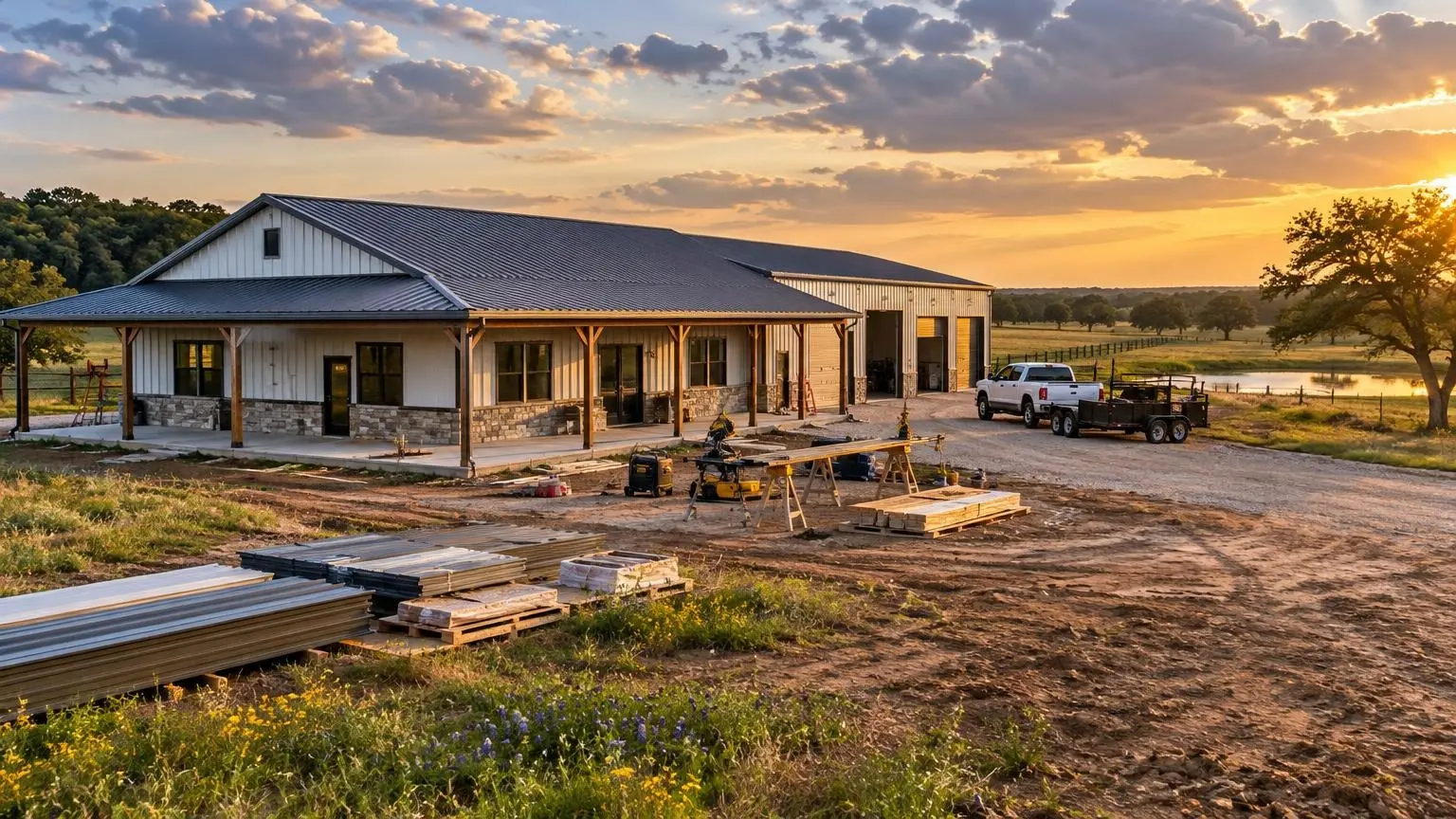
Barndominium builders around Dallas work on some of the hardest-moving ground in the country. Much of the land east of Fort Worth is Blackland Prairie clay, the soil locals call black gumbo, which shrinks when dry and swells when wet. We plan and build barndominiums, shop houses and metal building homes on acreage across Dallas-Fort Worth, and we start every project with the land, the county rules and the slab.
Why the slab matters here
The USDA Houston Black soil series, mapped across the Texas Blackland Prairies, runs 40 to 60 percent clay. In dry spells it cracks half an inch to 4 inches wide and a foot or more deep, and those cracks stay open 90 to 150 days in most years. A barndo slab poured on that ground without the right prep can move. We look at the soil, the drainage around the pad and the foundation design before we price the shell.
Heat, hail and the odd hard freeze
Dallas summers average a high of 96 degrees in July and August, with heat indexes regularly above 105. The metro sits at the lower end of Tornado Alley, and spring fronts bring hail and heavy rain. Then there are freezes like February 2021, when DFW Airport hit 2 below zero. A metal-skinned house has to handle all of it: we plan insulation, vapor control and HVAC sizing together so the inside stays dry and comfortable.
County rules, not city rules
Most barndominium land sits outside city limits, where the county, not a city building department, handles permits. In Collin County, for example, a new home in the unincorporated area needs a third-party inspector for at least three inspections: foundation, framing and mechanical, and completion. ETJ properties are still permitted through the county. Every county is a little different, so we research yours before we draw up a price.
Septic on rural lots
If the land is not on sewer, the house needs an on-site sewage facility permit. Texas septic rules come from TCEQ, and counties and some cities run the permits as TCEQ authorized agents. In Collin County, lots divided in 2008 or later need at least 1 usable acre for septic, or 1.5 acres if there is a water well. We factor septic design and placement into the site plan from the first visit.
What we build
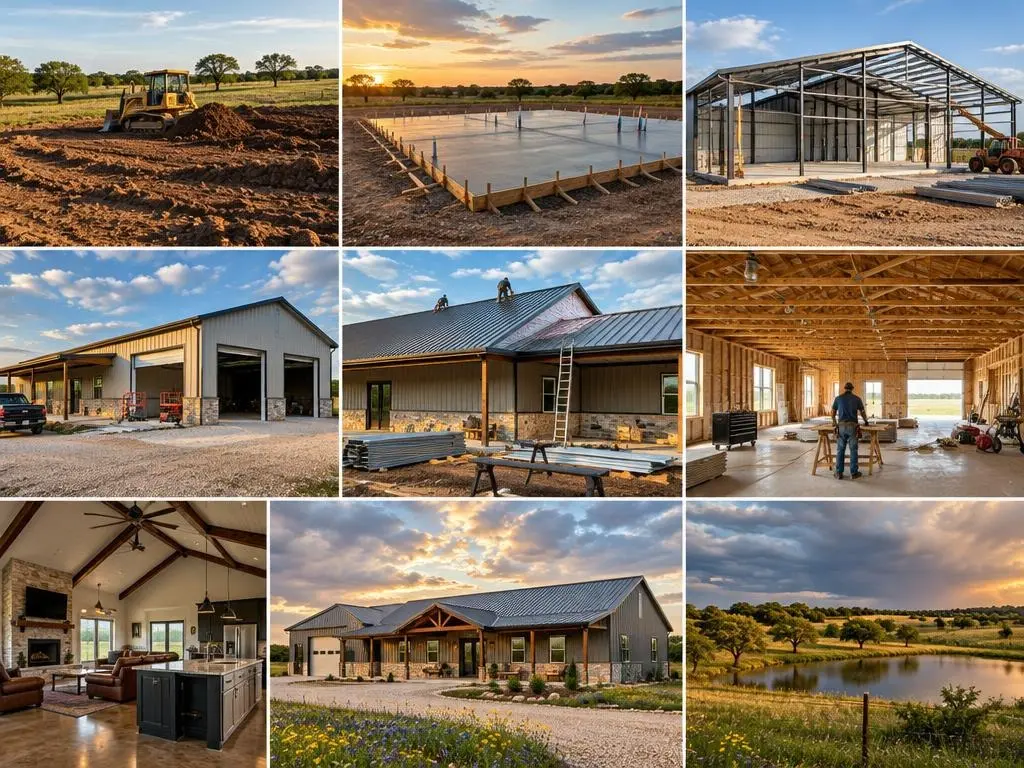
- Custom barndominiums from bare land to move-in
- Kit packages assembled on your slab
- Floor plans developed around how you live and work
- Shop houses with living quarters and large bays
- Metal building homes with conventional finishes
- Interior finish-out of existing shells
Steel or post-frame
Both are common here. Steel frames give wide clear spans for shops; post-frame (wood) costs less per square foot in many cases and is easier to insulate in some layouts. We walk through the trade-offs for your plan and budget.
Financing basics
Barndominiums can be financed, but appraisals are harder because there are fewer comparable sales. HomeGuide notes that farm credit lenders familiar with barn-style buildings are more likely to lend when you bring detailed plans. A complete plan and a line-item estimate make that conversation easier, and we provide both.
Why Homeowners Call Barndominium Builders Dallas
We see the land first
Every estimate starts with a visit to your property: soil, slope, drainage, trees, access, and where the house, shop, driveway and septic field can go.
Line-item written pricing
Your estimate lists site prep, slab, shell, insulation, mechanical and finish-out separately, so you can compare options and give a lender a clear budget.
County and septic research
We check whether your land is in city limits, an ETJ or the county, what inspections apply, and what the septic permit will need before we lock in a site plan.
A plan for heat and condensation
Metal envelopes sweat when warm, humid air hits cold steel. We plan the insulation, vapor control and HVAC together for North Texas summers and winter cold snaps.
Common Questions
How much does it cost to build a barndominium in Dallas?
Most of the price depends on the size, the finish level and how much work the land needs. Site prep, septic, a well and the interior choices move the number the most. Our Custom Barndominium Construction page lists typical cost ranges from published cost guides, and we price your project from a site visit with a written estimate.
Is a barndominium cheaper than a regular house?
Often, at the shell stage, because a steel or post-frame shell goes up quickly with fewer framing members. Finished costs depend mostly on interior choices; HomeGuide puts interior and exterior finishing at about 40 percent of total cost. A plain finish keeps a barndo well below a comparable custom home, while high-end finishes close the gap.
Can I build a barndominium in Dallas County or inside city limits?
Inside city limits, zoning, building codes and any HOA or deed restrictions decide what is allowed, and some neighborhoods restrict metal exteriors. Most barndominiums go up on acreage outside city limits, where the county handles permitting. We check zoning, deed restrictions and county rules for your parcel before you design.
Do I need a permit to build a barndominium in an unincorporated Texas county?
Usually yes, for septic at minimum, and many counties require more. Collin County requires a permit for any project that disturbs ground or adds footprint, plus a third-party inspector for at least three inspections on a new home. Outside a city, the septic permit comes from the county or other TCEQ authorized agent.
How much land do I need for a barndominium with septic?
It depends on the county and when the lot was created. In Collin County, lots divided in 2008 or later need at least 1 usable acre for a septic system, or 1.5 acres with 1 usable acre if you also drill a water well. Easements and ponds generally do not count as usable.
Steel frame or post-frame: which is better for North Texas?
Neither is right for every build. Steel frames suit wide-open shops and tall bays. Post-frame (wood) shells often cost less per square foot. We compare both for your floor plan, soil and budget.
Can you get a mortgage on a barndominium in Texas?
Yes, but it can take more legwork. Appraisals are harder because there are fewer comparable sales, which limits conventional options. HomeGuide notes farm credit lenders that finance barn-style buildings are more likely to approve a loan with detailed plans. Most rural builds start with a construction loan; a complete plan and itemized estimate help.
How do you keep a metal barndominium from sweating?
Condensation forms when warm, moist air reaches a cold steel surface. Spray foam applied directly to the metal skin, a planned vapor control layer, and HVAC that removes humidity are the usual fixes.
Barndominium Services
Six ways we help you build a barndominium on North Texas land.
Custom Barndominium Construction
Bare land to move-in: site prep, slab, shell, dry-in and finish-out in one plan.
Learn more →Barndominium Kits
Steel or post-frame kit packages erected on a properly prepped slab, with clear pricing on what the kit leaves out.
Learn more →Barndominium Floor Plans
Layouts worked out around your land, family and shop space before anyone draws final plans.
Learn more →Shop Houses
A working shop and a home under one roof, with the shop built for your equipment and the house built for comfort.
Learn more →Metal Building Homes
Steel-framed homes with conventional finishes inside and out, built for North Texas wind, hail and heat.
Learn more →Barndominium Interior Finish-Out
Turning an empty steel or post-frame shell into a finished home: insulation, framing, mechanical and finishes.
Learn more →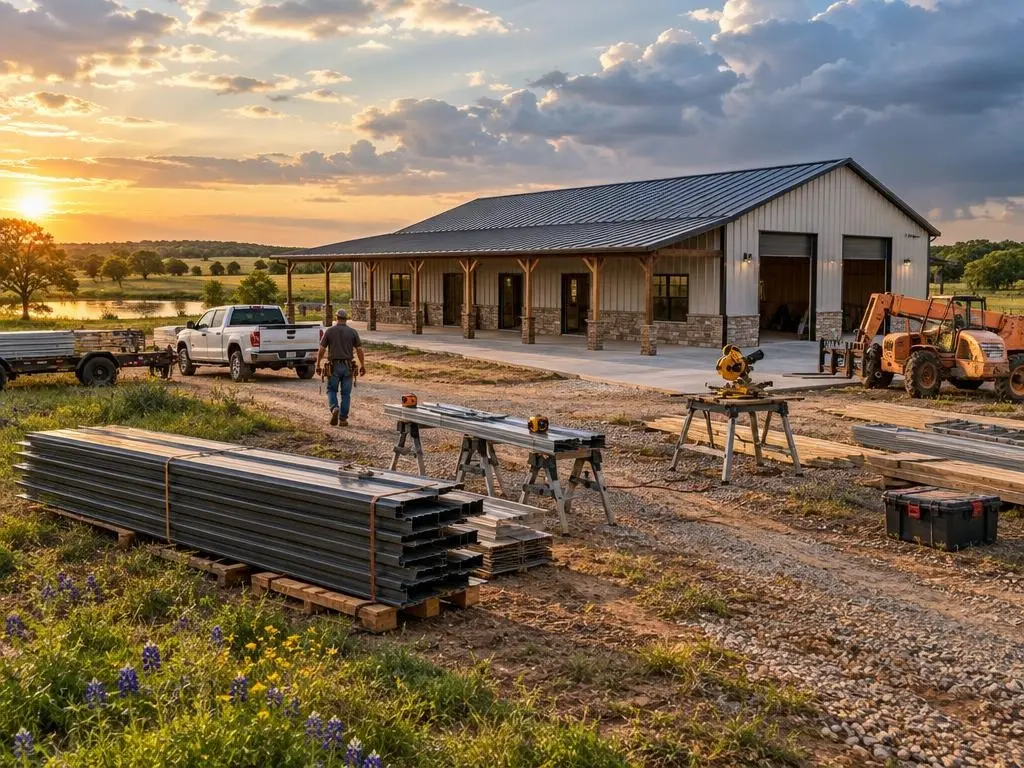
Barndominium Building Across DFW
We build across Dallas-Fort Worth, an 11-county metro area (Collin, Dallas, Denton, Ellis, Hunt, Johnson, Kaufman, Parker, Rockwall, Tarrant and Wise) that the 2020 census counted at more than 7.6 million people. Most barndominium buyers here look for acreage on the edges: Kaufman, Rockwall, Collin, Denton, Wise, Parker, Hood, Johnson and Ellis counties.
East and north: Blackland Prairie
Kaufman, Rockwall, Collin and Ellis counties sit largely on the Texas Blackland Prairies, a belt of dark, alkaline clay that runs about 300 miles from the Red River to San Antonio. Less than one percent of the original prairie is left; most of it became farmland and now subdivisions and small acreage tracts. The clay is fertile and flat, but it is the reason slab prep, moisture control around the foundation and good surface drainage come first on these builds. Septic systems on slow-draining clay often need engineered designs.
West: Cross Timbers and Fort Worth Prairie
West of Fort Worth the land changes. The Western Cross Timbers cover large parts of Wise and Parker counties, around towns like Weatherford: post oak and blackjack oak on coarse, sandy soils and rolling hills. The USDA Windthorst series, with its type location in Parker County, has a sandy loam surface over subsoil that is 35 to 50 percent clay. Parts of Denton, Johnson, Parker, Tarrant and Wise counties are Fort Worth Prairie, with rockier soil and mostly ranch land. Here, tree clearing, driveway length and rock can drive site costs more than clay does.
In between: the Grand Prairie and Eastern Cross Timbers
The Grand Prairie, a flatter strip between the two Cross Timbers bands, takes in Fort Worth, Granbury and Denton. The narrow Eastern Cross Timbers forest runs through Denton, Tarrant and central Johnson counties, with Cleburne along its eastern side.
Permits by county
Outside city limits, the county handles septic and development permits, and each county has its own process. Collin County, for example, requires a permit for any project that disturbs ground or adds footprint, does not assign addresses to raw land until permitting, and sends culvert and driveway inspections to its Public Works department. We confirm the rules for your parcel before you commit to a plan.
- Barndominium Builders in Dallas, TX
- Barndominium Builders in Forney, TX
- Barndominium Builders in Terrell, TX
- Barndominium Builders in Kaufman, TX
- Barndominium Builders in Royse City, TX
- Barndominium Builders in Rockwall, TX
- Barndominium Builders in Wylie, TX
- Barndominium Builders in Princeton, TX
- Barndominium Builders in Farmersville, TX
- Barndominium Builders in Anna, TX
- Barndominium Builders in Celina, TX
- Barndominium Builders in Pilot Point, TX
- Barndominium Builders in Aubrey, TX
- Barndominium Builders in Sanger, TX
- Barndominium Builders in Decatur, TX
- Barndominium Builders in Springtown, TX
- Barndominium Builders in Azle, TX
- Barndominium Builders in Weatherford, TX
- Barndominium Builders in Aledo, TX
- Barndominium Builders in Granbury, TX
- Barndominium Builders in Cleburne, TX
- Barndominium Builders in Burleson, TX
- Barndominium Builders in Midlothian, TX
- Barndominium Builders in Waxahachie, TX
- Barndominium Builders in Ennis, TX
- Barndominium Builders in Red Oak, TX
Get a Barndominium Estimate on Your Land
Free on-site estimates across Dallas-Fort Worth. Call (469) 310-8310 or send your land details.